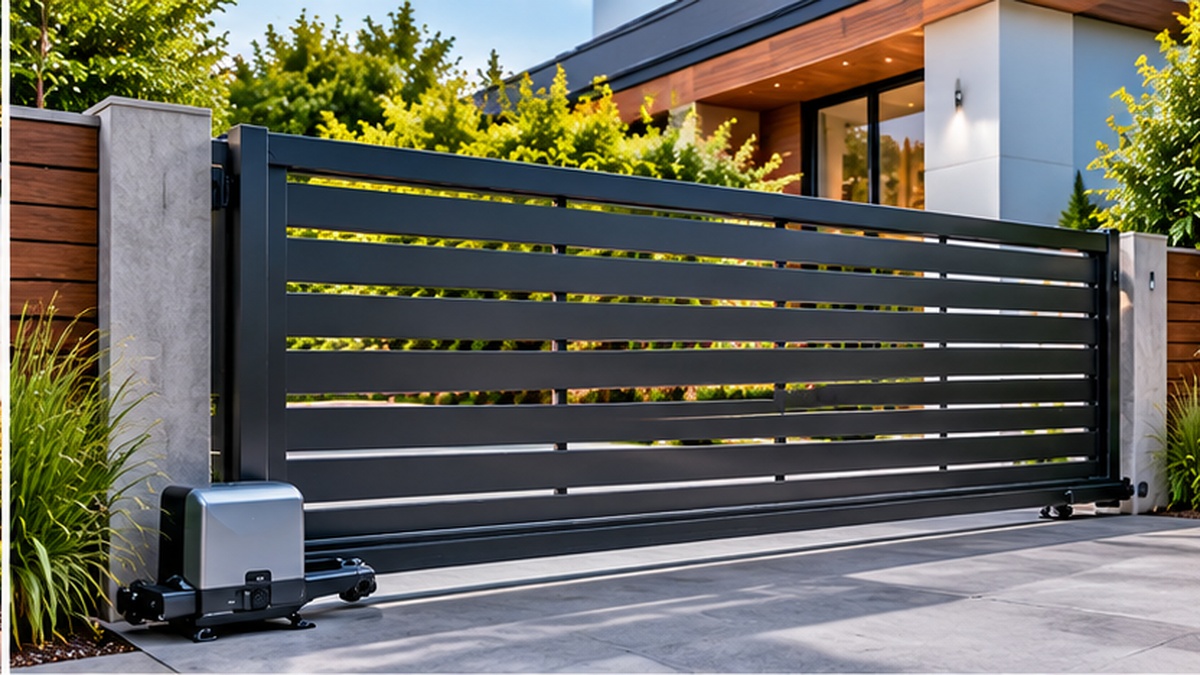
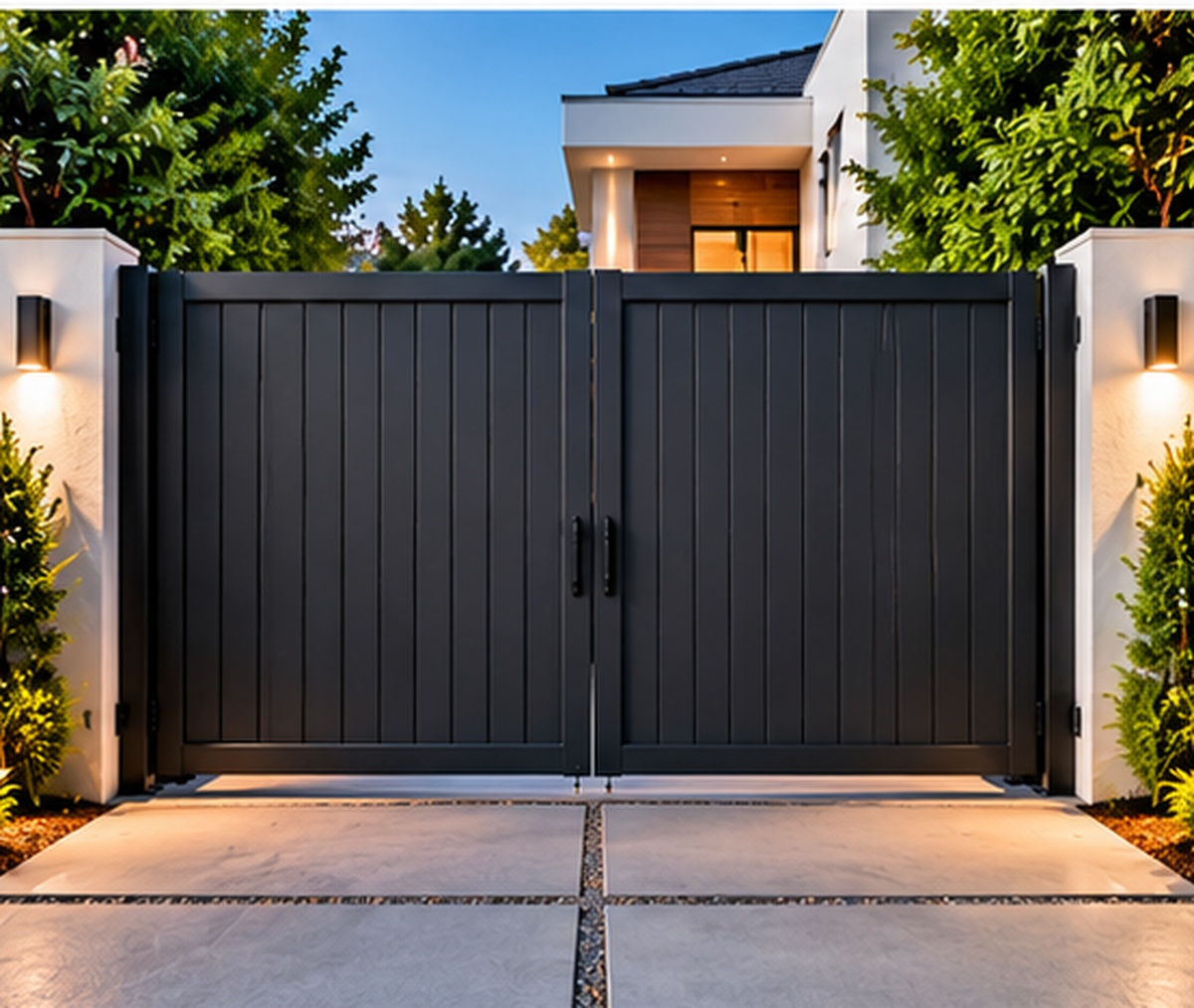
A sliding gate's motor does the work that makes the gate automatic. It drives the gate open and closed, holds it in position, and takes the commands that let a car pass without anyone leaving the driver's seat. When that motor or its operator gives out, the gate stops moving, and a Los Angeles property is left with a heavy gate that will not open or close on its own. A failed operator is one of the more involved sliding gate problems, and getting it right takes a technician who understands gate motors and controls. Sliding gate repair on a failed operator is work HeroTec Inc. handles across Los Angeles and the San Fernando Valley.
A sliding gate operator is a system of a motor, a drive, a control board, and the electrical parts that run them, and a failure can come from any of them. Knowing how these operators fail, and why a proper diagnosis matters before anything is replaced, is what separates a sliding gate repair that fixes the gate from one that swaps parts and hopes.
How a Sliding Gate Operator Fails
A sliding gate operator fails in several ways, and the symptom often points to the cause. A motor that hums or cycles but does not move the gate may have a failed capacitor, a stripped gear, or a mechanical bind stopping the gate. A motor that is dead entirely may have burned out, lost power, or suffered a failed control board. A gate that runs slowly, struggles, or overheats and shuts down may have a motor working too hard against a binding gate, or a motor near the end of its life. A gate that runs erratically, reverses without reason, or stops partway often has a control, limit-switch, or sensor problem rather than a motor failure. Because the same symptom can come from different causes, a sliding gate repair starts with a full mechanical and electrical diagnostic to find the real problem before any part is replaced.
The capacitor is a common and often-missed culprit. A gate motor's capacitor gives it the boost to start moving, and a failed capacitor leaves a motor that hums but cannot start the gate, a symptom easily mistaken for a burned-out motor. Replacing a failed capacitor is a far smaller repair than replacing a motor, which is why an honest diagnosis matters, since it can be the difference between a minor fix and an unnecessary operator replacement. HeroTec diagnoses to the actual failure, so a Los Angeles property owner pays for the repair the gate needs, not the biggest one.
A Humming Motor Is Often the Capacitor
A gate motor's capacitor gives it the boost to start, so a failed capacitor leaves a motor that hums but cannot move the gate, a symptom easily mistaken for a burned-out motor and a far smaller repair than a replacement.
Cycle Load Decides Operator Life
A residential sliding gate may cycle a handful of times a day while a commercial gate cycles a hundred or more, so an operator sized for light use fails fast on a high-cycle gate, which is why replacements must match the real workload.
The Failure Is Often Electrical
A sliding gate operator is as much electrical as mechanical, and a failed control board, limit switch, or a power surge can leave the gate dead or erratic, so a good diagnosis checks the electronics, not just the motor.
When a sliding gate operator fails, the question is whether to repair it or replace it, and the answer depends on the operator's age and condition. A newer operator with a failed capacitor, a worn gear, or a bad control board is usually worth repairing, since the core motor is sound. An older operator, especially one of the AC-motor setups from the 1990s and early 2000s, that has burned out or failed structurally may be better replaced with a modern DC operator, which offers better control and reliability. A motor that has failed because it was undersized or overworked for the gate's cycle load may need not just replacement but a properly sized operator matched to how much the gate actually runs. HeroTec assesses the operator honestly and recommends the repair when it makes sense and replacement when the operator is genuinely done, so the fix fits the gate and the property.
Matching the operator to the gate's workload matters, because a Los Angeles sliding gate's cycle load varies enormously. A single-family residential gate may cycle a handful of times a day, while a commercial or multi-tenant gate can cycle a hundred times or more, and an operator sized for light use fails fast on a high-cycle gate. When a sliding gate repair involves replacing the operator, sizing it to the real cycle load is what keeps the new operator from failing as quickly as the old one, which HeroTec accounts for in any replacement.
The Electrical Side
A sliding gate operator is as much electrical as mechanical, and the electrical parts are behind many operator problems. The control board, the receiver, the limit switches that tell the gate where to stop, and the wiring all have to work for the operator to run correctly, and a fault in any of them can leave the gate dead or erratic. Power surges and grid problems, which Los Angeles sees, can damage a control board. A technician handling a sliding gate repair on a failed operator checks the electrical side, the board, the switches, the connections, and the power, not just the motor, because the failure is often there. HeroTec's technicians handle the full mechanical and electrical diagnostic, so an operator problem gets traced to its real source whether it is the motor or the electronics.
A Repair Done to Last
A sliding gate operator repair done right identifies the true failure, fixes it with the correct part, and confirms the gate runs correctly and safely afterward. HeroTec's factory-trained technicians diagnose the operator fully, present the repair or replacement options and the flat-rate cost before starting, and complete the work with quality parts from a stocked truck. After the repair, the technician tests the full open-and-close cycle, the limit switches, and the safety sensors, so the gate moves and also stops safely and holds position. The work is backed by a one-year workmanship warranty, with financing available for a larger operator replacement.
The Brands and Systems on LA Gates
Los Angeles sliding gates run a range of operator brands, and a sliding gate repair company has to know them all. DoorKing, LiftMaster, FAAC, and Viking are among the operators common on LA gates, each with its own controls, parts, and service quirks, and a technician familiar with them diagnoses and repairs faster than one seeing a brand for the first time. HeroTec's technicians work across these operator brands, so a sliding gate repair on a LiftMaster, a DoorKing, or a FAAC operator is handled by someone who knows the system. That brand familiarity matters on the electrical side especially, where the control boards, receivers, and programming differ between manufacturers.
Why Diagnosis Comes First
The most important part of a sliding gate operator repair is the diagnosis, because the same symptom can come from very different causes at very different costs. A gate that will not move might need a capacitor, a small part, or a full operator, a large one, and only a proper diagnostic tells which. A sliding gate repair that skips the diagnosis and jumps to replacing the operator risks charging a property owner for a new motor when a capacitor would have fixed it, while one that patches without finding the real fault leaves the gate to fail again. HeroTec's full mechanical and electrical diagnostic identifies the actual failure before any part is quoted, so a Los Angeles property owner pays for the repair the operator needs. That honest, diagnosis-first approach is what separates a sliding gate repair that solves the problem from one that guesses at it.
A Repair That Fits the Gate and the Budget
Every sliding gate operator repair should fit both the gate and the property owner's budget, and that starts with an honest assessment and a clear, flat-rate quote. HeroTec diagnoses the operator, explains what failed and why, presents the repair-or-replace options with the trade-offs, and quotes a flat rate before any work begins, so a Los Angeles property owner makes an informed choice rather than being handed a bill. For a larger operator replacement, financing is available, so a failed operator does not force a difficult decision. That transparency, paired with factory-trained technicians and a one-year workmanship warranty, is what makes a sliding gate repair on a failed operator something a property owner can trust rather than dread. A gate motor that gives out is a solvable problem, and the right diagnosis and honest options are what solve it well.
When a sliding gate motor gives out, a Los Angeles property owner needs a company that finds the true failure through a full diagnostic, offers honest repair-or-replace options, and stands behind the fix with a real warranty. HeroTec brings that to every sliding gate operator repair across Los Angeles and the San Fernando Valley, from a simple capacitor replacement to a full modern DC operator installation sized to the gate, backed by a California contractor license, stocked service trucks, and a one-year workmanship warranty on the work.
HeroTec Inc. is a licensed gate contractor, California License #1098568, serving Los Angeles and the San Fernando Valley from its Canoga Park shop, with same-day service, 24/7 emergency response, and a live dispatcher. When a sliding gate motor gives out, the right diagnosis is the whole fix. For dependable sliding gate repair on a failed operator, contact HeroTec Inc. at (747) 777-4667 for service or a free quote.
About Canoga Park, CA
Neighborhood in California, US
Neighborhood of Los Angeles
Canoga Park, Los Angeles
Canoga Park, Los Angeles (the Los Angeles metropolitan area)
Canoga Park is a neighborhood in the city of Los Angeles, California, located in the San Fernando Valley. Before the Mexican–American War, the neighborhood was part of a rancho, and after the American victory it was converted into wheat farms and then subdivided, with part of it named Owensmouth as a town founded in 1912. It was annexed by Los Angeles in 1917 and was renamed Canoga Park on March 1, 1931, after Canoga, New York.[2]
In 1863, the syndicate San Fernando Homestead Association led by Isaac Lankershim and Isaac Van Nuys purchased the southern half of the historic San Fernando Valley. They established seven wheat ranch operations and were the first to ship wheat to Europe from California. In 1869, Alfred Workman acquired the westernmost ranch, a 13,000 acres (50 km2) wheat farm in future Canoga Park (for more: See Landmarks section below).[11] Eucalyptus trees were introduced into the San Fernando Valley by Albert Workman, who imported seedlings from his native Australia and planted them on the Workman Ranch. In time, they spread through the Canoga Park area ranches, farms and beyond. It has been said that these trees are the parents of all eucalyptus trees in Southern California.[12][13]
1920 Sherman Way in downtown Owensmouth, with Los Angeles Pacific Railroad lines visible at right
The area was originally named Owensmouth by Los Angeles Suburban Home Company by general manager Hobart Johnstone Whitley as a sales tactic in that the town would be the new mouth of the Owens River, after the Los Angeles Aqueduct would be completed the next year. The town was founded on March 30, 1912, and the Suburban Home Company contracted with the Janss Investment Company, to sell properties. A pre-development scheme brought Pacific Electric streetcars and an all purpose highway (Sherman Way) out all the way from Hollywood through Cahuenga Pass, through the previously subdivided Van Nuys (1911). Highlighting the "opening day barbecue" was the display of the "Owensmouth Baby", a racecar that could go up and down the paved Sherman Way at the incredible speed of 35 mph.
A sign for Canoga Park's old town center on Sherman Way
Owensmouth, as the junior San Fernando Valley city to Van Nuys, promoted itself with the "baby" motif—using storks in their advertisement. The "baby city" of the Valley remained a very small community.
The lack of an independent water supply made annexation to the City of Los Angeles inevitable, and on February 26, 1917, it joined with its larger neighbor. The name was changed to Canoga Park in 1931, thanks to the efforts of local civic leader Mary Logan Orcutt.[14] Eventually, the area's zoning was rural/agricultural and its industry was small farms involved in the production of fruits, vegetables, and melons, some livestock, horses, a movie/television studio, and a stunt location.[15]
The Canoga Park Airstrip occupied the area now known as "Warner Center" (as shown on the street map 1955 Thomas Guide).
Canoga Park has hosted a Memorial Day Parade for over three decades. The parade is organized by local representatives from the Canoga Park Community Center and local business leaders. It pays tribute to fallen servicemen and women from all branches of the U.S. Armed Forces. A flyover by the Condor Squadron serves as the kickoff of the parade. A special ceremony for fallen heroes from Canoga Park High School, including those dating back to World War II is part of the opening presentation.[16] The parade route goes along Sherman Way.
Founded in 2000, the festival celebrated its 25th anniversary in 2025. It is one of the biggest Day of the Dead celebrations in the San Fernando Valley.The festival spans eight city blocks along Sherman Way between Topanga Canyon Blvd. and Canoga Ave and is attended by thousands of people. The festival happens on the first Sunday of November every year. The day long event includes live music, altars, art, food, children's activities, a catrina contest and a classic car show featuring lowriders, motorcycles and low rider bicycles.[17]
In 1955, Rocketdyne, then a division of North American Aviation (NAA), moved into the area and built its main manufacturing facility in Canoga Park. The facility became a major employer along with the Atomics International and Santa Susana Field Laboratory (SSFL) divisions of NAA.[18] Other aerospace companies followed: including Thompson Ramo Wooldridge-TRW, Hughes Aircraft, Rockwell International, Boeing, and Teledyne. Small machine shops and other ancillary businesses also sprang up to service the aerospace industry. The Rocketdyne facility was in the end operated by Aerojet Rocketdyne, who moved out of Canoga Park in 2014. Demolition and site clearing of the former Rocketdyne facility in Canoga Park commenced in August 2016.[19][20] The Santa Susana Field Lab property has also been closed[when?] and will be[when?] undergoing an extensive environmental cleanup, and become an open-space park.[21][22]
This article needs to be updated. Please help update this article to reflect recent events or newly available information.(August 2025)
In 1987, much of the western district of Canoga Park was renamed West Hills. On June 25, 2005, Canoga Park was named an All-America City a first for the city of Los Angeles.[23]
The use of toxic chemicals like trichloroethylene and tetrachloroethene as cleaning solvents during production by aerospace and defense contractor companies in their Canoga Park industrial facilities led to groundwater pollution on their sites and across the neighborhood.[24][25][26]
Since 2003, environmental testing on a former Litton Industries, later Northrop Grumman, industrial site revealed unsafe levels of toxic chemicals on the site; 2007 tests further revealed that toxins had spread to an area beyond the site. In 2021, a petition for a class action against Northrop Grumman on behalf of affected residents was filed. The petition sought monetary compensation for losses in property value and called on Northrop Grumman to mitigate the contamination, alleging that the chemicals had leaked from the site and contaminated groundwater under 3,200 properties in an area about 2.4 miles long and 1.8 miles wide and that the corporation failed to properly contain or remediate the damage after it acquired the site in 2001. The corporation argued that they had complied with the California State Water Resources Control Board and that the Board had approved their actions.[24][25]
A June 2024 report on soil vapor and groundwater inspections conducted near the vacant Rocketdyne site, delivered to the California State Water Resources Control Board on behalf of RTX Corporation, reported levels of toxic cleaning solvents that were above levels that could pose a threat to the environment and human health. According to the LA Times in August, several residents of apartments which had been inspected reported that they were not notified of the testing nor of test results.[27] The Water Board confirmed that they were reviewing the report and responded about 7,000 individuals in residences and businesses within 500 feet of the site were notified. The Board also reported that they had notified some 4,000 Canoga Park residents about exposure to toxic chemicals from the former Litton Industries site.[26]
Bell and Dayton Creeks flowing from the Simi Hills, and Arroyo Calabasas (Calabasas Creek) from the Santa Monica Mountains are several of the headwaters of the Los Angeles River that originate in the western San Fernando Valley that flow through Canoga Park. The Los Angeles River itself begins at the confluence of Calabasas Creek and Bell Creek behind Canoga Park High School. These and other small creeks supply storm water and suburban runoff water to the Los Angeles River, and several are considered year round creeks. Although the creeks are now channeled and run within concrete walls, they do form a significant urban wildlife landscape and contribute to the population of indigenous wildlife left within the San Fernando Valley.[28]
This area experiences hot and very dry summers. According to the Köppen Climate Classification system, Canoga Park has a hot-summer Mediterranean climate, abbreviated Csa on climate maps.[29] Precipitation is more common from December to March. Temperatures in the daily high range from 19 °C (66 °F) to 34 °C. Daily low temperatures range from 5 °C (41 °F) to 14 °C.
The 2000 U.S. census counted 53,227 residents in the 4.35-square-mile (11.3 km2) Canoga Park neighborhood—or 12,240 people per square mile, about an average population density for the city. In 2008, the city estimated that the population had increased to 60,578. In 2000, the median age for residents was 30, also about average for city and county neighborhoods.[31]
The neighborhood was considered "highly diverse" ethnically within Los Angeles. The breakdown was 50.9% Latino; 30.7% White; 11.1% Asian; 4.3% Black; and 3.1% other. Mexico (45.8%) and El Salvador (11.6%) were the most common places of birth for the 42.8% of the residents who were born abroad—which was about an average percentage for Los Angeles as a whole.[31]
The median yearly household income in 2008 dollars was $51,601, considered average for the city. Renters occupied 63.6% of the housing stock, and house- or apartment-owners held 36.4%. The average household size of three people was average for Los Angeles. The 18.1% of families headed by single parents was also average for city neighborhoods.[31]
The percentage of residents aged 19 to 34 was among the county's highest, as was the percentage of never-married men (40.4%).[31]
Main Street Canoga Park is the historical designation for downtown Canoga Park along Sherman Way. The area was once known as "Antique Alley" and has a lot of vintage boutiques, coffee shops and art.[32]
Los Angeles Police Department Topanga Community Police Station serves residents in Canoga Park, parts of Winnetka, West Hills, and Woodland Hills. The Topanga Community Police Station opened in January 2009. The police department named the station after a village in the Tongva language of the historically local Tongva-FernandeñoNative Americans tribe. The department originally planned to name it the Northwest Station, but residents preferred a name linking to the town's history.[33] Prior to the opening of the Topanga station, the Devonshire Community Police Station served addresses north of Roscoe Boulevard while the West Valley Police Station served addresses south of Roscoe Boulevard.[34]
Lanark Recreation Center, formerly Orcutt Park, is an LA City park in Canoga Park (21816 Lanark Street and Topanga Canyon Boulevard, 91304). The center has a lighted baseball diamond, an unlighted baseball diamond, lighted indoor basketball courts, lighted outdoor basketball courts, a children's play area, a lighted football field, an indoor gymnasium (without weights), picnic tables, a lighted soccer field, lighted tennis courts, lighted volleyball courts, and an auditorium. It also serves as a Los Angeles Police Department drop-in site.[44]
Lanark Pool, an outdoor unheated seasonal pool, is on the park site.[44][45]
Jimmy Osmond, (b. 1963), singer, businessman, actor, entertainer; the only member of The Osmonds not to have been born on their hometown of Ogden, Utah[54]
^Ogden Hoffman, 1862, Reports of Land Cases Determined in the United States District Court for the Northern District of California, Numa Hubert, San Francisco
Should I repair or replace my sliding gate operator?
It depends on age and condition. A newer operator with a failed capacitor, worn gear, or bad board is usually worth repairing, while an older AC-motor unit that has burned out may be better replaced with a modern DC operator sized to the gate's cycle load. HeroTec assesses honestly and recommends the fix that fits.
What makes a sliding gate operator fail early?
Often being undersized or overworked for the gate's cycle load, a light-duty operator fails fast on a high-cycle gate. Power surges, heat, and lack of maintenance also shorten its life. HeroTec sizes any replacement operator to the real cycle load, so the new one does not fail as quickly as the old one.